
There is a version of swimming that begins with a number: a distance, a time, a target to improve.
There can also be a visit to the ocean that does not ask you to bring home a result. Not a challenge completed. Not a photograph that proves how far you went. Simply time beside the water, with swimming an option only when the setting, conditions, and your abilities make it appropriate.
No distance goal does not mean no plan. It means the plan puts people and conditions ahead of a number.
Make the decision before the moment becomes a dare
The water can look inviting without being suitable for swimming. Check current local beach forecasts, closures, water-quality notices, and posted instructions. The National Weather Service advises speaking with the lifeguard or beach patrol about current water conditions before entering.
Choose a lifeguarded setting and follow the lifeguard's directions. If there is uncertainty about suitability, stay out. This article does not assess a beach, establish your swimming ability, or provide an ocean-swimming lesson.
You have not wasted the trip if the right decision is not to swim.
Go with company, not pressure
The National Weather Service recommends swimming with one or more buddies. A friend should not become an audience for a test of courage.
Talk about the actual plan, listen when someone wants to stop, and do not make the least comfortable person responsible for keeping everyone else entertained.
A buddy does not remove the need for lifeguards, suitable conditions, or appropriate skills. Do not assume one confident swimmer can make an unsuitable outing appropriate for another person.
Leave the target on shore
When swimming is appropriate, the absence of a distance goal can leave room to pay attention to the experience rather than a counter. That does not mean ignoring your surroundings or swimming without agreed boundaries.
Do not use an article to choose how far offshore to go, how long to remain in the water, or which conditions you can manage. Those decisions need current local guidance and an honest understanding of your own ability.
Being a capable pool swimmer does not make this reflection a substitute for ocean-specific instruction.
Notice without needing to perform
You might remember the color of the water that day or the sound of voices when you return to shore. You might mostly remember how welcome the towel felt.
There is no need to promise a dramatic sense of renewal. Swimming can be enjoyable without becoming a story about transformation.
It can also feel different from what you expected. You do not have to insist that it was wonderful just because you had looked forward to it.
Keep cold out of the challenge
This is not an invitation to cold-water endurance, breath-holding, or pushing past discomfort. Ask appropriate professionals about individual health concerns and seek qualified instruction for skills you have not learned.
Do not use a timer, another person's enthusiasm, or a social-media trend as evidence that you should stay in. Follow current lifeguard guidance and attend promptly to any difficulty.
No health benefit or therapeutic outcome is promised here.
The sea does not owe you yesterday's conditions
A place you enjoyed before may be different on the next visit. Familiarity is not a current assessment.
Read official information, talk to the lifeguard, and do not treat a quiet-looking interval or a pattern in the waves as proof that it is safe to enter.
The National Weather Service's rip-current resources explain why checking conditions matters. Read the full official guidance rather than relying on a few lines in a lifestyle article.
Let getting out be an ordinary decision
You do not need to finish a number before you are allowed to stop. Follow the agreed plan and local directions, and do not let the wish for one more moment outweigh a concern.
A short, appropriate swim is not an unfinished long one. It is its own outing.
If someone is in trouble, alert a lifeguard or call 911. Do not turn a buddy arrangement into an improvised rescue that puts another person at risk.
Make room for the part afterward
Leave time for the practical things your own circumstances require: drying off, changing where permitted, gathering belongings, and checking in with the people you came with.
Then, if you want, sit somewhere appropriate and look at the water you were just in. There is no need to immediately decide what the next visit will be.
A conversation, something to eat, or the journey home can be part of the day without becoming a reward you have to earn by swimming far enough.
A shore-side day still belongs to the ocean
Perhaps the conditions are unsuitable. Perhaps you are tired, uncertain, or simply do not want to get in once you arrive.
Stay on an appropriate path, find a suitable place to sit, or choose a different outing. You can listen to the water without entering it.
You do not need to turn that choice into a consolation prize. Looking at the sea is not a failed swim.
With children, supervision comes before the mood
Do not use the relaxed tone of this piece as permission to relax supervision. Follow lifeguard directions and appropriate water-safety practices, and choose activities suited to the child's abilities and the actual conditions.
A child does not have to enter the ocean to make a family beach day complete. Avoid dares, comparisons, or pressure to prove confidence.
Seek qualified instruction rather than treating a reflective article as a teaching plan.
What you might bring home
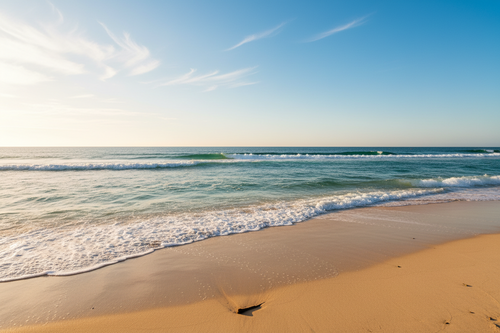
Not a distance. Perhaps a detail: a shade of blue, the way the beach looked from your resting place, a conversation you did not rush.
Or perhaps nothing you need to put into words.
The visit does not have to become a personal best. It can be an ordinary day at the coast, shaped by good judgment and the freedom to change your mind.
Sources and transparency
This is an editorial reflection, not a firsthand account of Laura completing a particular swim. It gives no route, distance, duration, medical clearance, or assurance of suitable conditions. Safety context was reviewed through official National Weather Service search extracts; consult the full guidance and current local instructions.
- National Weather Service: Actions to Take at the Beach to Protect You, Your Family and Others. Speaking with lifeguards, swimming with buddies, and obtaining emergency help.
- National Weather Service: Rip Current Safety. Checking conditions and using current official beach information.
Your next step: plan a coastal visit with no swimming target attached. Check the conditions and talk to the lifeguard, then let the appropriate choice, including staying out, be enough.