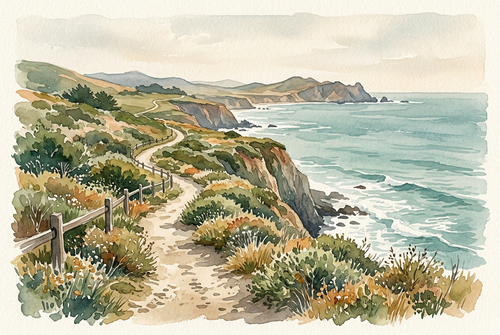

Quiet confidence does not have to look like a daring voyage or a photograph taken at the edge of a cliff. It can look like checking a route, choosing a manageable walk, asking a question, or deciding that today is not the right day to continue.
A coastal outing offers opportunities to practice those decisions, but it does not guarantee a change in how you feel about yourself. You do not need to return transformed. This is an invitation to notice the small choices that make an experience your own, without turning the sea into a test.
Choose an outing you do not have to prove yourself against
Start with what suits you now: your energy, mobility, time, budget, companions, and level of experience. A familiar promenade or designated viewpoint can be a complete outing. You do not need unfamiliar terrain, open water, or a remote destination to make it count.
Check the operator's current access information, route details, facilities, local weather and hazards, and site rules before leaving. Bring the clothing, supplies, navigation information, and personal care essentials the outing calls for. A short visit is still worth preparing for.
Make one decision deliberately
Instead of asking whether you are adventurous enough, ask a practical question: “What would make this visit workable?” Perhaps you need a route with suitable rest stops, a companion, a shorter distance, or a clearer return plan.
Choose one detail yourself. Compare two routes, check a facility you need, or agree on a turnaround time. The useful part is not making the boldest choice; it is making a choice with information rather than pressure.
If the planning feels unfamiliar, start small. Asking a visitor-center staff member a specific access question can be more useful than pretending you already know what to expect.
Let curiosity be separate from risk
You can wonder about a distant bird or the shape of a headland without moving closer. Stay on designated routes, respect closures and barriers, and remain well back from surf and cliff edges. Keep children closely supervised.
The large breaking waves in the featured image are not a challenge to approach. This article does not recommend entering rough water, climbing exposed rocks, or navigating currents to build resilience. Watching from an appropriate place and choosing not to proceed are valid decisions.
For ideas grounded in giving wildlife space, read How to Observe Marine Life Without Disturbing It.
Practice asking without apologizing for needing information
It is reasonable to ask what a route surface is like, whether a facility is available, or how long a return journey may take. Check practical details with the relevant operator rather than relying on an appealing description or another visitor's confidence.
A useful question is specific: “Does this route include steps?” or “Where can I find the current access notice?” You are not failing at exploration by gathering information. The map, the official guidance, and another person's expertise can all be part of your preparation.
Leave room to change your mind
Before setting out, decide what would make you shorten the visit: changing conditions, fatigue, access difficulties, or simply an outing that does not suit your group. Keep enough time and energy for the return.
A change of plan does not need a triumphant explanation. “This isn't working for us today” is enough. You can feel disappointed and still make a sensible choice.
For practical examples, explore How Coastal Weather Teaches Flexibility and Preparedness. Its focus is adapting to conditions, not pushing through hazards.
Notice the decision, not just the distance
Afterward, you might reflect on something concrete: you asked for information, chose a route that matched your needs, paused before getting overtired, or spoke up about what you wanted from the day.
You can write down one sentence if you like: “Next time, I would…” There is no score to improve and no requirement to feel more confident immediately. The outing can simply give you information about what works for you.
Carry the habit somewhere ordinary
The coast is not necessary for this practice. You can make an informed choice, ask a question, or change a plan on a neighborhood walk, at a library, or during an afternoon at home. If travel, cost, or access puts a coastal visit out of reach, the idea still belongs to you.
Quiet confidence, in the sense used here, is not fearlessness. It is leaving room for your own judgment, your own limits, and the help you need. An ordinary, well-chosen outing can be enough.