
A coastal outing can leave you with more questions than answers. What was that bird doing? Why did one patch of water look darker? Was the shape on the distant rock an animal, or only a shadow?
You do not need to answer everything on the spot. A simple field notebook can give those questions somewhere to go. The aim is not to turn a family visit into schoolwork. It is to make a little space between noticing something and deciding that you know what it means.
Choose one place, not an entire coastline
Start with a designated viewpoint or established route suited to your group. Check current access, weather, hazards, facilities, and site rules before leaving. Consider surfaces, steps, mobility needs, supervision, and the return journey. A place to pause comfortably may matter more than a dramatic destination.
You do not need to combine a forest, beach, and tide-pool visit in one trip. One stopping place and one question are enough for this activity. It does not require entering the water, approaching wildlife, collecting objects, or moving closer to an edge.
Bring paper and a pencil you already own, along with the ordinary supplies your outing calls for. Budget for transport and current entry or parking charges where applicable. There is no special notebook to buy.
Try a short observation pause
At a suitable stopping place, invite anyone who wants to join in to choose one visible detail. Spend a few minutes looking, listening, describing, or sketching. The length is flexible; a young child may be ready to move on much sooner than an adult.
Keep your description close to what you can actually observe. “A bird walked along the sand and stopped three times” is different from “the bird was looking for its family.” The first records an action; the second offers an explanation you have not established.
Imagination is welcome too. Simply give it its own space: “It reminded me of…” can sit beside an observation without pretending to be a fact.
A notebook page you can copy
Use some or all of these prompts. A spoken answer or an adult writing down a child's words works just as well as a completed page.
- Place and date: where we observed, and when.
- What I noticed: a description, sound, shape, or small sketch.
- What I think might explain it: a guess, clearly marked as a guess.
- What I want to find out: one question to take home.
- What I checked later: the source and what it did or did not answer.
There is no requirement to fill every line. An unanswered question is a useful record, not a failed exercise.
What that might look like
Here is a hypothetical example, not a report of a particular outing:
Noticed: “A bird repeatedly lowered its head toward the sand.”
Guess: “It might have been finding food.”
Question: “What clues would help us identify the bird and understand what it was doing?”
Back at home, you might compare a sketch or photograph with a reputable bird guide. If you cannot identify it confidently, keep the description rather than choosing a name to complete the page. You can record uncertainty honestly.
Adapt the idea to the child, not the other way around
For a toddler, try one color, one sound, or a gesture toward something interesting. An adult can write down the child's words, but there is no need to require a drawing or an explanation. Stay close and keep the visit manageable.
For an older child, offer the choice of sketching, describing, comparing shapes, or asking a question. Someone who does not enjoy writing might prefer to talk. Participation can remain optional; quiet company is part of a family outing too.
For a broader selection of activities, read Coastal Learning Activities for Kids on the California Coast. This notebook approach is one way to follow up on a detail, rather than a list of things everyone must do.
Follow the question home
Choose a source that fits the question: a park's official interpretation for a local feature, a reputable field guide for identification, or a museum or library resource for a subject you want to explore. Record where the information came from and whether it actually answers your question. A quick search result is not a reason to pretend you have identified an animal or explained a landscape.
If a question concerns local history or culture, seek sources that name the people, place, and period involved, including relevant community or Tribal sources where appropriate. Avoid turning a broad label into the story of an entire coastline.
Care for the place while you learn
Stay on designated routes, respect closures and barriers, leave natural and cultural features in place, and watch wildlife from a distance. Keep children closely supervised and remain well back from surf and cliff edges. Do not let finishing a page become a reason to enter an unsuitable area.
For practical ways to make care part of the outing, explore Teaching Environmental Respect Through Exploration.
A classroom does not have to be outdoors
If weather, cost, access, or energy makes a coastal visit impractical, try the same page with a view from a window, a familiar neighborhood plant, or a photograph. Be clear about what you observed directly and what you saw in an image.
The useful habit is portable: notice carefully, separate a guess from an observation, and leave room to find out more. The coast can be a starting point without needing to provide every answer.
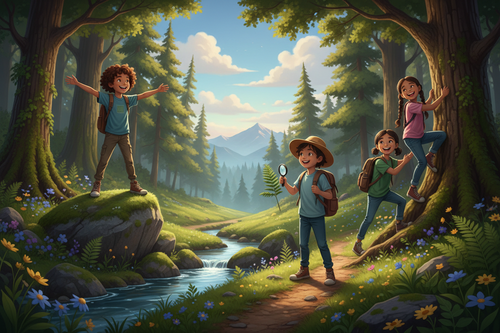
The featured image is an illustration of a family notebook activity, not a photograph or guide to a named location.