
The book has been beside your bed for weeks. You like it. You want to read it. Somehow, by the time the day becomes quiet, your attention has already gone elsewhere.
A beachside reading hour is a small change of setting, not a reading challenge. Take one book to a practical coastal stopping place and give it a little of your day. The ocean does not need to become the backdrop for a photograph, and you do not have to finish a chapter to justify the trip.
Your reading break at a glance
- Suggested time: Set aside 30–60 minutes at the destination, plus travel. A shorter visit counts too. These are editorial suggestions, not a route duration or required routine.
- Where: A permitted seating area near the California coast, with access and conditions that work for you. You do not need to reach the sand.
- Cost: Use a book you own or borrow. Check transport, parking, and entry charges. Buying a drink or a new book is optional.
- Bring: One book or reading device, water, suitable clothing and protection for the conditions, your usual essentials, and a bookmark.
- Access: Confirm seating, shade, toilets, route surface, steps, and distance from parking directly with your chosen location.
Choose the reading experience you want
Ask what sounds inviting today rather than what you feel you should read. A familiar novel can be comforting. A short essay offers a natural stopping point. Poetry may suit an afternoon when you want to look up often.
If choosing becomes another task, bring the book you have already started. You can also ask your library for a short-story collection or a book that fits your interests. Check local borrowing arrangements rather than assuming a particular title or format will be available.
Find comfort before opening the book
Read the destination’s official visitor information for current hours, closures, facilities, and restrictions. Choose a permitted stopping place away from waves, cliff edges, and unstable ground, without blocking a path. Follow barriers and posted instructions.
Consider how you will sit, whether there is shelter from wind, and whether the light makes reading comfortable. Do not assume shade or seating will be available. If the place does not work when you arrive, change the plan instead of trying to make the photograph in your head happen.
For a flexible outing plan around your reading time, A Slow California Beach Morning: A Solo Reset Without a Shopping List offers a simple beginning and end. Borrow the parts that suit your day and leave the rest.
Pack for one quiet activity
A single book is enough. Carry it in a suitable bag you already own and keep it away from food, wet towels, and loose sand. Use a cover or pouch if you have one suited to the job, but do not assume it is waterproof.
If you are using a reading device, follow its care instructions and plan around charge, glare, and exposure to the elements. This guide does not compare the environmental impacts of paper and digital formats.
If your bag tends to collect supplies for every possible outing, try Beach-Bag Reset: Pack Less for a California Day Out. Keep your real essentials, then choose one optional pleasure for the time you actually have.
Give your attention an easy entrance
Before reading, take a moment to settle and notice where you are. Find your place in the book. If you have forgotten what happened, skim a page rather than deciding you must start again.
You might put your phone out of easy reach while keeping it accessible for your needs. Choose notification settings that do not interfere with necessary contact or caregiving responsibilities. There is no rule that a meaningful break must be completely disconnected.
Read in small stretches
Try a few pages, then look up. Let a distant sound or a change in the light be part of the afternoon rather than an interruption you must defeat.
If your mind wanders, return to a paragraph you enjoyed or change to a shorter piece. If you spend most of the time watching the view, the visit has not failed. Reading for pleasure does not need to become another productivity measure.
If you are coming with children
Distinguish a family reading outing from a solo reading break. When you are responsible for supervising children, keep that responsibility first; an absorbing book is not a substitute for attention near water or other hazards.
For a family version, choose a suitable place away from hazards and share a short read-aloud. If another adult is joining, agree clearly who is supervising and when. Do not assume someone else has taken over because you have opened your book.
Leave the book unchanged, especially if it is borrowed
Use a bookmark rather than folding a borrowed page. Keep notes on separate paper, and pack the book away if weather or spray threatens it. Take loose paper and rubbish home.
A useful record might be one sentence in your own words: “I want to know what happens next.” You do not need to copy passages or photograph pages to remember the experience.
A coastal reading hour without the drive
If the beach is not practical, create the same small pause near a window, in a suitable local outdoor space, or in a comfortable chair at home. Read a coastal story if that appeals, or simply keep a favorite coastal photograph nearby.
There is no need for a special playlist, themed drink, or new decor. Protecting a little time may be the most useful part of the plan.
End with a reason to return
Mark your page and decide where the book will live when you get home. An easy-to-reach place can make the next reading moment less complicated. You can stop at an interesting point rather than pushing through until you are tired.
About this guide
This is an original editorial outing plan, not a personally tested itinerary, a reading prescription, or a claim of health benefits. Timings and prompts are suggestions. No specific destination’s accessibility, fees, facilities, or current conditions have been verified. Check its official visitor information before leaving. No purchase is required.
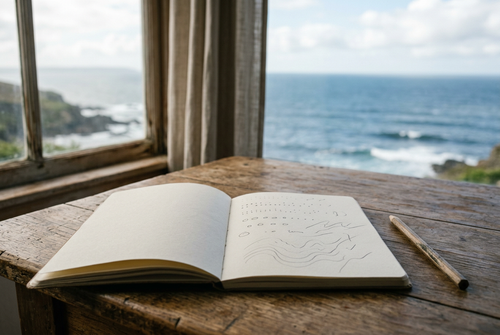
The featured watercolor is an imagined reading scene. The book and location are illustrative, not a recommended title, documented visit, or technical demonstration of suitable barriers or distances.
Your next step: choose one book you already have access to, identify a practical place to sit, and set aside a small pocket of time. One good paragraph can be enough to bring you back.