
“Where do you think that cloud is going?” can be the beginning of a story. So can a crooked line on a page, a pretend boat, or a child announcing that the ocean needs a birthday cake.
This afternoon is an invitation to invent something together, not a lesson your child has to complete. It is written with mothers in mind, but another caregiver can join in just as easily. You need neither a coastal address nor a collection of new craft supplies.
Your story session at a glance
- Suggested ages: Adaptable for toddlers through school-age children with adult supervision. Follow your child’s interests and communication style rather than expecting a particular result.
- Suggested time: 10–30 minutes of storytelling, plus any travel. These are editorial estimates; a two-minute story can be enough.
- Where: At home, or in a permitted California coastal seating area suitable for your family. The activity does not require entering the water or reaching the sand.
- Cost: No new supplies are needed if you have paper and a drawing tool. Check transport, parking, and entry costs if going out.
- Bring: Optional paper and appropriate drawing tools, water, suitable clothing, and your family’s usual essentials.
- Access: For an outing, confirm route surfaces, steps, seating, toilets, and distance from parking directly with the site.
Choose a place where you can stay attentive
If visiting the coast, read the destination’s official information for current conditions, hours, closures, and rules. Use a permitted stopping place away from hazards and follow barriers and posted instructions. A story should never become a reason to wander toward water, wildlife, or cliff edges.
Keep supervision first. If you cannot comfortably tell a story and supervise in the setting you have chosen, save the storytelling for home. This is not a water-play activity or a site-specific safety assessment.
1. Begin with one thing you can notice
From your stopping place, choose a color, a cloud shape, or a distant feature. At home, use a coastal photograph you took, a drawing, or a remembered scene.
Make the boundary between observation and invention clear: “We can see a cloud. In our pretend story, it could be a traveling pillow.” You can enjoy imagination without presenting made-up animal behavior or natural history as fact.
If your child would rather notice than invent, A Coastal Observation Walk With Kids in California: Notice More, Collect Less offers drawing and listening prompts. You can keep the observation as it is rather than requiring it to become a story.
2. Choose a character together
Offer a simple choice if an open question feels too large. Would the main character be a little boat or a wandering cloud? A child can point, gesture, draw, use a communication device, or answer aloud.
Let the character be original. A purple boat that dislikes splashes is enough; it does not need to belong to a familiar movie or have a detailed backstory.
3. Use three small story questions
- Who is here? Name or describe the character.
- What do they want? Perhaps to find a quiet place, deliver a letter, or choose a birthday song.
- What happens next? Add one event, then see whether your child wants another.
For example: “A little cloud wanted to send a postcard. It could not hold a pencil. What could it try?” That is an invented story starter, not a description of weather.
For toddlers: repeat more, ask less
One option is to try one character and one repeated phrase. You might say, “Little boat looked this way,” pause for a gesture, then repeat it with a different direction.
If your child changes the subject or wants to repeat the same moment, follow that interest. There is no need to prompt a beginning, middle, and end. Watching or listening can be participation too.
For older children: offer a choice, not a worksheet
Invite your child to choose between two endings, give the character a surprising helper, or tell the next sentence. You can alternate sentences if that feels fun, without correcting the story into your preferred version.
If your child asks a factual question, separate it from the invention. “That happened in our pretend story; let’s look up what real birds do later.” Write down the question if needed.
4. Draw a three-picture keepsake
If you both want a record, divide a page into three spaces: the character, something that happens, and the ending. A mark or a dictated sentence can stand in for a detailed drawing.
An adult manages tools and selects materials appropriate to the child. Keep small parts and unsuitable supplies out of reach. There is no need to collect shells, plants, rocks, or animals as props.
5. Let your child name the story
Write down the title in their words. “Boat Goes There” is as valid as a carefully constructed title. Add the date and, if you like, a short note about where you made it up.
You can keep the page or an audio recording within the family. Ask whether your child wants a record, and let keeping it private be the default rather than turning the activity into public content.
When the story goes nowhere
Sometimes the character never leaves the first sentence. Sometimes your child wants a snack, or you realize you are too tired to ask another question. Stop there.
You can say, “We can finish another day,” or let the unfinished version be the whole story. A shared activity is not more valuable because it produces something displayable.
A full version for home
Look at a coastal picture you made, draw a blue line, or simply say, “Imagine a little boat.” Choose a character, invent one problem, and offer two possible next steps.
No ocean soundtrack, new book, or themed costume is required. If being outside does not suit your family today, nothing essential is missing.
For another day, A Library-and-Nature Day With Kids in California pairs a library visit with an optional outdoor pause. It is a separate outing idea, not another step you need to add to this afternoon.
About this guide
This is an original editorial family activity, not a personally tested itinerary, developmental assessment, or promise of educational outcomes. Age adaptations and timings are suggestions. No specific location’s current conditions, fees, facilities, or accessibility have been verified. Confirm those through official destination information before an outing. The sample characters and story situations are fictional.
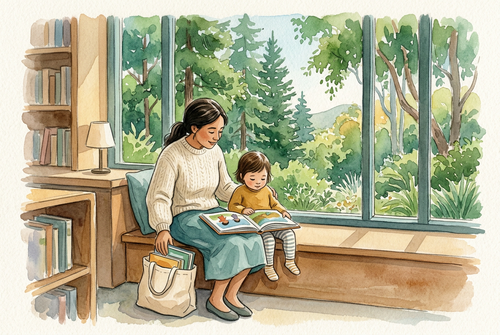
The featured watercolor is an imagined adult-and-child drawing scene, not a documented family visit, tested workshop, or demonstration that the pictured supplies suit every child.
Your next step: ask your child to choose between a little boat and a wandering cloud. Add one wish, one thing that happens, and as much silliness as the afternoon allows.