
You do not need a bucket of shells to bring something home from the coast. A remembered sound, a quick drawing, or a child’s wonderfully unexpected question can be enough.
This short family walk is about noticing rather than collecting. Use a designated coastal path, keep wildlife undisturbed, and let the length of the outing follow your family’s energy rather than a checklist.
Your outing at a glance
- Location: A designated coastal walking route in California. Choose a specific site and check its official visitor information before leaving.
- Suggested ages: Adaptable for toddlers through school-age children with adult supervision. Route suitability depends on your child and the site.
- Suggested time: 15–40 minutes, including pauses. This is an editorial estimate, not a route duration.
- Cost: The activity requires no new equipment if you have paper and a pencil. Parking, admission, and transport costs vary.
- Bring: Water, suitable clothing and footwear, a pencil, scrap paper or a notebook, and any supplies your family ordinarily needs. A camera or binoculars are optional.
- Accessibility: Confirm surface, gradient, steps, seating, toilets, and distance from parking directly with the site. A coastal path is not automatically stroller-friendly or wheelchair-accessible.
Before you go: choose the route, not just the view
Check the land manager’s current information for closures, weather, route conditions, and local wildlife guidance. Look for a short route with an easy turnaround point. Stay on designated paths and follow barriers and posted instructions. If the conditions or route do not suit your family, choose another location or save the outing for another day.
This activity does not require entering the water, walking on slippery rocks, or visiting tide pools. Keep young children closely supervised, especially near water and steep edges.
Try three small noticing games
1. Find a coastal color palette
Ask each person to name three colors they can see without leaving the path. Younger children can point; older children can sketch a few color patches or invent names such as fog gray or seaweed green. You do not need to pick anything up.
2. Listen, then describe
Pause at a suitable stopping place and notice nearby sounds. Can you hear wind, birds, waves, or people? Invite children to describe a sound with a word, gesture, or drawing. Adapt this prompt to the senses and communication styles that work for your family.
3. Draw one tiny detail
Choose something visible from your stopping place: a leaf shape, a cloud, a distant bird, or a pattern in the landscape. Make a quick drawing. The aim is attention, not a recognizable picture. If you take photos, keep your distance rather than approaching wildlife for a closer shot.
For optional ways to record a question or observation, see The California Coast as a Living Classroom: A Family Field Notebook. One scribble or dictated sentence can be enough.
Let wildlife stay wild
The Bureau of Land Management’s California Coastal National Monument guidance recommends observing wildlife from a distance, not feeding or approaching it, staying on designated paths, and packing out what you bring. Its site rules apply to monument lands; check the rules at your particular destination as well.
For this activity, leave plants, rocks, shells, and animals where they are. Take drawings or memories instead. Follow the site’s wildlife-distance instructions and do not approach animals for a better view.
Teaching Environmental Respect Through Exploration offers related adult-led habits for leaving discoveries in place without turning the outing into a collecting challenge.
If tide pools are part of a separate visit
Read the California Coastal Commission’s tidepooling guidance before planning a tide-pool outing. It advises checking tides, watching the ocean, using footwear with grip, stepping only on bare rock or sand, and not touching, poking, or removing animals. These are selected points, not a complete preparation checklist.
A low tide alone does not establish that conditions are suitable for your family. A path-based observation walk is a different activity and does not need to include tide pools. Follow current local guidance rather than using this article to decide where or when to enter an intertidal area.
Make it work for your child
For a toddler, noticing one bird or one moving leaf may be the whole activity. Offer a choice between two prompts, then follow their interest. For an older child, try a short field-note entry: what did you notice, what do you wonder, and what would you like to learn later? Avoid guessing an animal’s identity as fact; write down the question and investigate together afterward.
A nearby or indoor alternative
Use the same prompts on a neighborhood path, from a suitable park bench, or through a window. Draw the sky, compare colors, and notice movement. There is no need to make a long drive just to complete this activity.
An optional next step
Explore the free Coastal Nature Scavenger Hunt printable if your family enjoys a checklist. This is a digital PDF, not a physical item. Treat it as a noticing guide, not a collecting challenge. You can also write three prompts on scrap paper and skip printing entirely.
How this guide was researched
This is a researched activity suggestion, not a personally tested route or a site-specific safety assessment. Source review: October 28, 2026, using official BLM coastal visitor and California Coastal Commission tidepooling search extracts linked above. Activity lengths and age adaptations are editorial suggestions. No specific route’s current conditions or accessibility have been verified. No environmental savings have been calculated; the practical focus is observing without collecting and using supplies you already own.
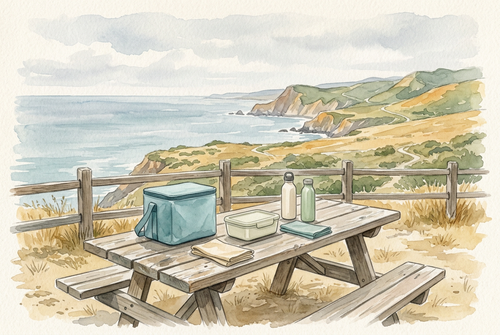
The featured watercolor is an imagined adult-and-child coastal scene, not a documented trail, an accessibility assessment, or a technical demonstration of suitable barriers or distances.
Start small: choose one suitable route, check its current visitor information, and pick a single noticing prompt. A short walk can still hold plenty of discovery.